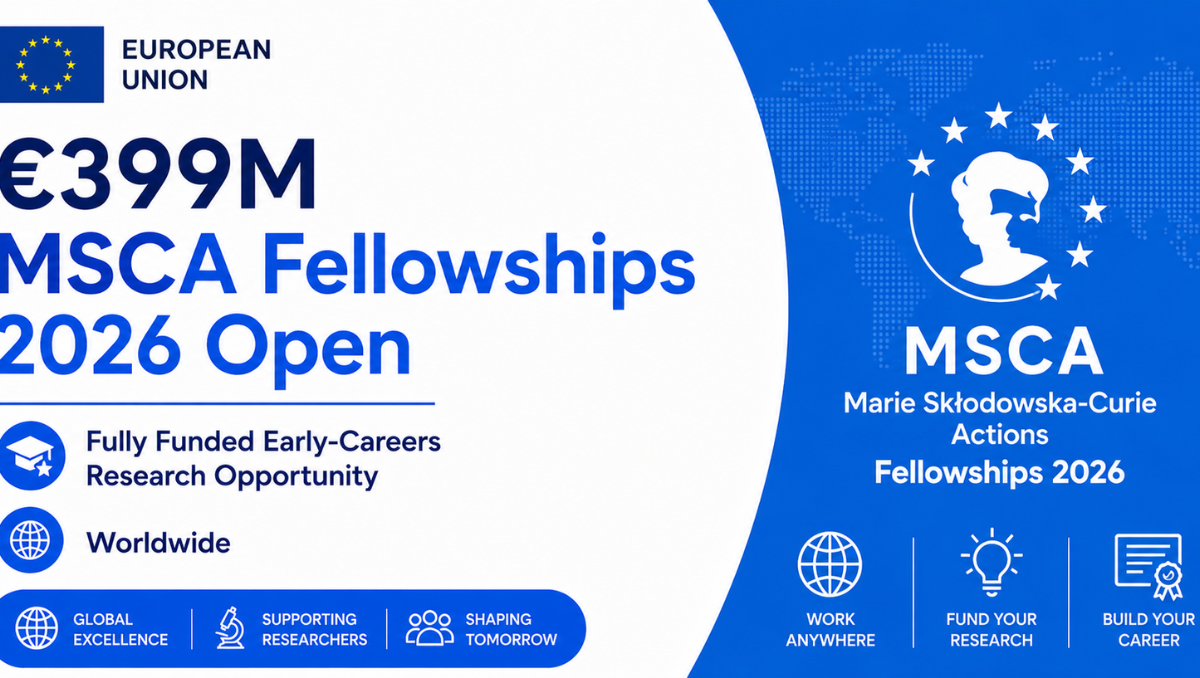

MSCA Postdoctoral Fellowships 2026 Open: €399 Million Flagship European Funding for Global Early-Career Researchers.The European Commission has officially opened the Marie Skłodowska-Curie Actions (MSCA) Postdoctoral Fellowships 2026 call, allocating a massive €399.05 million budget to fund approximately 1,600 cutting-edge research projects. Established as Europe’s premier flagship funding mechanism for postdoctoral talent, this completely unrestricted, fully funded program invites researchers from all over the world to pursue advanced training, interdisciplinary discovery, and international relocation.
The MSCA Postdoctoral Fellowships allow researchers holding a PhD to design their own customized research projects in tandem with a host institution. The program welcomes applications across all scientific disciplines—spanning the humanities, social sciences, life sciences, engineering, and digital data systems. By working alongside top-tier scientific figures and leading international teams, selected fellows gain world-class competencies to accelerate their academic or industrial careers.
MSCA Postdoctoral Fellowships 2026 Open: €399 Million Flagship European Funding for Global Early-Career Researchers
Program Structure and Fellowship Streams
The 2026 call offers two distinct application tracks tailored to different mobility patterns and national profiles:
1. European Postdoctoral Fellowships
- Target Audience: Open to postdoctoral researchers of any nationality worldwide.
- Mobility Direction: For researchers moving into Europe from a third country, or moving between different European borders.
- Duration: Full-time funding for 12 to 24 months.
- Host Allocation: Must be executed at a certified host organization within an EU Member State or a Horizon Europe Associated Country (such as the UK, Armenia, Georgia, Moldova, Ukraine, and others).
2. Global Postdoctoral Fellowships
- Target Audience: Restricted to nationals or long-term residents of EU Member States or Horizon Europe Associated Countries.
- Mobility Direction: Funds an outgoing phase to a non-associated third-country organization (e.g., institutions in the USA, Canada, or Australia), followed by a mandatory return phase to Europe.
- Duration: Full-time funding for 24 to 36 months (12 to 24 months for the outgoing global phase, plus a mandatory 12-month return phase to a European host).
Non-Academic Placement Allowance: Both pathways allow fellows to request an additional six months at the conclusion of their fellowship to complete a professional placement within a non-academic European organization (such as an NGO, business enterprise, hospital, or government body).
Financial Benefits and Remuneration Package
MSCA Fellowships provide a highly competitive, fully funded framework that completely covers institutional research costs and living expenses. The funding is paid out as a monthly allowance to the host institution, which recruits the fellow under a localized employment contract:
- Living Allowance: A baseline monthly salary to cover primary living expenses, adjusted dynamically via a country-correction coefficient to match local cost-of-living metrics.
- Mobility Allowance: A supplementary monthly allocation to assist with expenses related to international relocation and maintaining cross-border professional operations.
- Family Allowance: Additional monthly allocations provided to fellows with family obligations (regardless of whether the family relocates with the researcher).
- Special Needs Allowance: Financial support to assist researchers with long-term physical, mental, or health-related challenges.
- Institutional Allowances: Separate financial contributions paid directly to the host organization to cover core research, training, networking, and project management costs.
Eligibility and Screening Criteria
The European Research Executive Agency enforces strict baseline filters to preserve the competitive excellence of the MSCA program:
- Academic Threshold: Applicants must hold a formal PhD degree by the absolute call deadline (September 9, 2026). Candidates who have successfully defended their doctoral thesis but have not yet received their formal diploma are fully eligible.
- Research Experience Ceiling: Applicants must have a maximum of 8 years of full-time research experience following the official award date of their PhD. Documented career breaks, parental leave, or years spent completely outside of active research circles do not count toward this 8-year limit.
- The Mobility Requirement: Applicants must not have lived or carried out their main professional activity (work or studies) in the country of the primary host institution for more than 12 months within the 36 months immediately preceding the final call deadline.
- Resubmission Restriction Rules: Starting with the 2026 cycle, strict resubmission restrictions apply. Applicants who submitted an application to the previous 2025 MSCA Postdoctoral Fellowship call and received an evaluation score lower than 80% are not permitted to resubmit a proposal this year.
Host Institutions and Supervisory Support
An individual researcher cannot apply independently. Applications must be prepared jointly by the applicant and a designated Supervisor at a future Host Organisation.
Eligible host entities are not restricted to typical higher education sectors. Proposals can be submitted in partnership with:
- Public and private universities or elite academies.
- Independent international research facilities and tech centers.
- Commercial enterprises, tech startups, and Small and Medium-Sized Enterprises (SMEs).
- Government agencies, ministries, public health institutions, or museums.
- Non-governmental organizations (NGOs) and civic bodies.
Key Deadlines and Evaluation Process
- Official Call Opening Date: April 9, 2026
- Absolute Electronic Submission Deadline: September 9, 2026, at 17:00 CEST (Central European Summer Time)
- Results Notification Window: February 2027 (Expected)
- Grant Document Signatures: February to May 2027
- Earliest Project Launch Date: May 2027
Proposals are systematically evaluated by independent international experts across three strict award criteria: Excellence (50%), Impact (30%), and Quality & Efficiency of Implementation (20%). High-scoring projects (85% or higher) that miss out on funding due to strict budget limitations are automatically awarded the MSCA Seal of Excellence, opening doors to alternative regional financing.
How to Apply Successfully
- Locate a Host Institution and Supervisor: Search the EU Funding & Tenders Portal or use the Euraxess database to locate host organizations publishing Expressions of Interest (EoIs) for the 2026 call.
- Confirm Eligibility Configurations: Use the official MSCA Self-Assessment Tool to verify your exact years of postdoctoral research experience and confirm compliance with the mobility rule.
- Draft the Joint Research Proposal: Set up your administrative workspace under call reference HORIZON-MSCA-2026-PF-01-01 on the EU Funding Portal. Co-write the 10-page technical research plan alongside your prospective supervisor.
- Finalize Electronic Submission: Complete all structural parts (Part A for administrative metrics, Part B for scientific rationale) and submit the application package via the portal before the firm September closing deadline.
Frequently Asked Questions
1. Can an applicant submit multiple proposals with different supervisors?
No. Each researcher is strictly limited to submitting one application per call cycle to the MSCA Postdoctoral Fellowships scheme. If multiple proposals are registered under the same candidate’s passport details, all entries will be disqualified.
2. What are the ERA Fellowships linked to this call?
Applicants choosing a standard European Fellowship with a host organization located in an eligible “widening country” (regions with lower research and innovation performance indicators) can opt-in to the ERA Fellowships framework. This awards around 40 additional grants to top-performing files that missed out on main MSCA funding due to budget limitations.
3. Are researchers displaced by armed conflicts eligible for specific waivers?
Yes. The MSCA framework offers specialized integration pathways for researchers displaced by conflict (such as refugees). For these candidates, the standard international mobility rules are calculated with specific flexibilities to aid their integration into secure European research networks.
Suggested Focus Keywords: MSCA Postdoctoral Fellowships 2026 call, Marie Sklodowska Curie Actions budget open, Fully funded European postdoctoral research grant, Horizon Europe fellowship eligibility requirements, European vs Global postdoctoral mobility rules, How to apply MSCA funding portal, Research experience self assessment tool.
Meta Title: €399M MSCA Postdoctoral Fellowships 2026 Call Now Open Worldwide
Please note: jobsss.site is an independent international educational and career intelligence platform. We maintain no official partnership, endorsement, or structural affiliation with the European Commission, the European Research Executive Agency (REA), or the Horizon Europe framework. We independently analyze and synthesize public research calls to help global scholars navigate competitive academic funding pathways successfully.
ALSO CHECK : Canada Scholarships 2026: Comprehensive Guide for International Students Applying Without IELTS