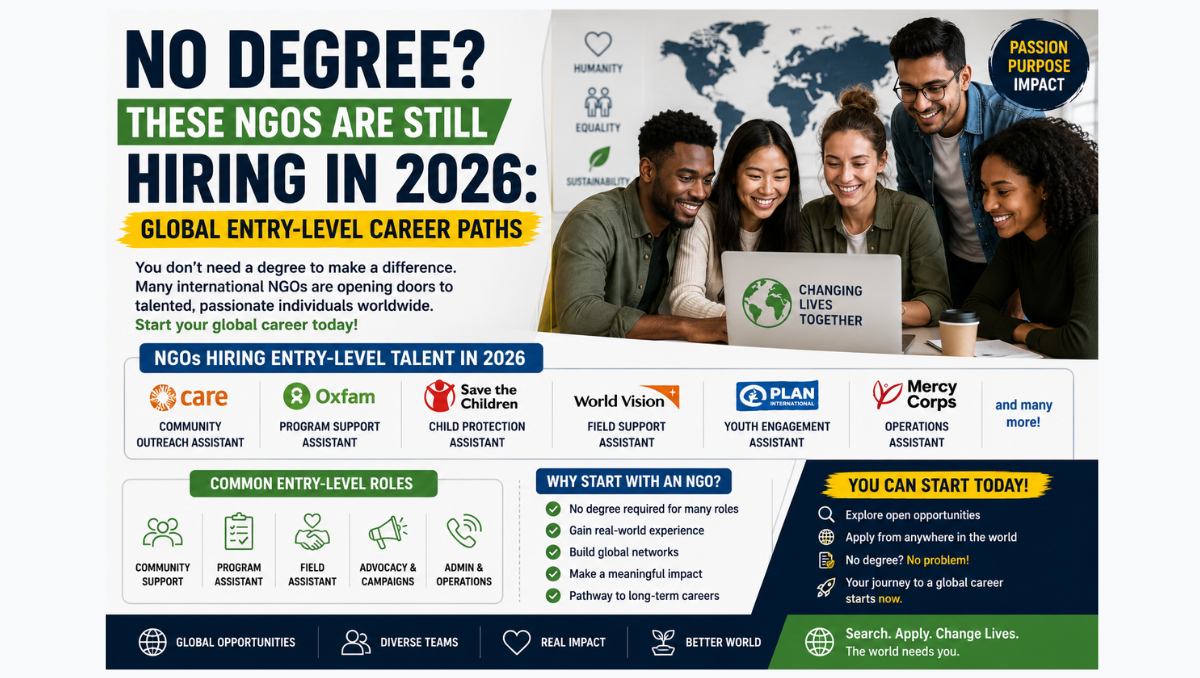

No Degree? These NGOs Are Still Hiring in 2026: Global Entry-Level Career Paths.Breaking into the humanitarian and international development sector has historically felt like navigating an elite, credential-heavy maze. For years, formal university degrees were treated as mandatory entry tickets by major international non-governmental organizations (INGOs). However, a profound operational shift is underway across the global development landscape.
In 2026, leading organizations are actively removing rigid educational filters for a wide variety of essential field, operational, and technical roles. Facing complex humanitarian crises, localized development mandates, and rapid digital transformations, NGOs are prioritizing lived experience, practical skills, and community-level trust over university diplomas. This structural evolution opens a practical gateway for determined individuals to launch high-impact, globally collaborative careers without holding an advanced degree.
This comprehensive guide breaks down the high-demand entry pathways currently available in 2026, details exactly what global recruiters are looking for, and provides direct application links to top international organizations with active hiring initiatives.
No Degree? These NGOs Are Still Hiring in 2026: Global Entry-Level Career Paths
The Evolving Non-Profit Sector: Skill-First Hiring in 2026
The contemporary NGO ecosystem operates on a dual-track strategy. While policy, strategic research, and highly specialized medical programs still require formal institutional credentials, the engine room of global development—consisting of project deployment, logistics management, technology support, and field operations—runs entirely on practical execution.
Organizations have recognized that localized knowledge, technical fluency in trade skills, and high emotional intelligence are better indicators of field success than a general undergraduate diploma. By adopting skills-first hiring models, global non-profits are widening their recruitment funnels to attract diverse talent segments. This approach allows them to secure dedicated, hands-on professionals who can immediately execute operational tasks in fast-paced environments.
High-Demand Operational Roles Not Requiring a Degree
When exploring non-degree pathways within international NGOs, candidates should target critical operational frameworks. These core sectors keep global relief operations functioning and routinely offer entry points based on vocational competency and practical experience.
Field Logistics and Supply Chain Support
Global field logistics forms the literal backbone of any major relief program. The entire distribution mechanism relies heavily on structured processes that track resources from initial donor procurement down to last-mile community delivery.
As illustrated in the structural diagram above, the operational workflow transitions through distinct stages where practical, degree-free expertise is highly valued:
- Central Distribution & Warehousing: Organizing, auditing, and maintaining inventory levels for emergency supplies, medical kits, and food reserves.
- Transportation Coordinating: Managing regional fleet movements, securing transport routes, and tracking delivery timelines across varied terrain.
- Last-Mile Distribution: Interfacing directly with local distribution points to ensure resources securely reach the final beneficiaries.
Community Mobilization and Liaison Officers
These positions act as the human interface between international agencies and local target communities. Agencies look for individuals with deep cultural awareness, strong communication skills, and local language fluency to explain program objectives, register project beneficiaries, and manage feedback channels. Lived experience in target regions is considered far more valuable here than formal academia.
Administrative, Data Entry, and Program Support
Every field office requires a dedicated administrative framework to function. Responsibilities typically include maintaining project databases, organizing local procurement paperwork, scheduling fleet movements, and compiling initial data fields for Monitoring, Evaluation, Research, and Learning (MERL) workflows. High proficiency in standard office suites and meticulous attention to detail are the primary currencies for these roles.
Information Technology and Digital Field Support
As development initiatives become increasingly digital, NGOs deploy remote data collection tools, field-level biometric registration systems, and satellite communication equipment. Individuals with proven technical capabilities in network troubleshooting, hardware maintenance, or IT support desk management can easily bypass formal degree requirements by demonstrating hands-on technical proficiencies.
Qualifications, Experience, and Practical Equivalencies
While the requirement for a university degree may be waived, recruiters still maintain rigorous baseline standards. To successfully pass applicant tracking systems, candidates must display clear operational competencies.
Education & Certification Equivalencies
Alternative credentials can dramatically enhance an applicant’s resume. Professional certifications showcase structural knowledge and a commitment to continuous learning:
- Logistics & Supply Chain: Certifications from the Chartered Institute of Logistics and Transport (CILT) or specialized humanitarian logistics training programs (such as Fritz Institute certifications).
- Project Management: Baseline certifications like CAPM (Certified Associate in Project Management) or foundational courses in Project DPro (Project Management for Development Professionals).
- Technical Trades: Formal vocational diplomas in mechanics, electrical systems, database management, or information technology.
Experience & Practical Capacities
Recruiters evaluate candidates using strict experience-equivalency formulas. Typically, a four-year degree requirement can be completely offset by a matching number of years spent in hands-on environments.
- Operational Contexts: 2 to 5 years of experience working in commercial logistics, warehouse management, local corporate administration, or military service.
- Volunteer History: Consistent, documented engagement with community groups, local non-profits, civil society organizations, or emergency response teams.
- Soft Skill Indicators: Demonstrated competence in high-stress adaptability, cross-cultural collaboration, active conflict resolution, and practical problem-solving.
Why Launch a Degree-Free Career in the NGO Sector?
Entering the non-profit sector via operational roles provides unique professional advantages that rival or exceed traditional corporate entry-level paths.
- Accelerated Field Exposure: Non-degree holders frequently enter through direct field support tracks, placing them on the front lines of program execution. This practical exposure builds specialized knowledge that cannot be replicated in a university classroom.
- Clear Lateral and Upward Mobility: The NGO sector highly respects operational competence. A professional who starts as a local warehouse assistant can naturally transition into a logistics coordinator, and eventually a regional operations manager, purely based on performance and tenure.
- Access to Specialized Professional Networks: Working within global organizations exposes individuals to international project directors, technical advisors, and institutional donors, opening diverse professional pathways.
- Immense Personal Fulfillment: Every successfully managed logistical route, correctly entered data point, or resolved community issue directly contributes to improving human lives and protecting vulnerable populations.
Strategic Application Tips for Non-Degree Candidates
When competing for global NGO roles without a traditional academic background, your application strategy must shift focus from where you learned to what you can execute.
- Pivot to a Functional Resume Layout: Restructure your CV to lead with a robust “Core Competencies” section. Group your experiences by functional skills—such as Inventory Management, Cross-Cultural Communication, or Fleet Coordination—rather than simply listing chronological employer names.
- Quantify Your Practical Accomplishments: Avoid vague descriptions of your previous duties. Use concrete metrics to prove your capabilities (e.g., “Managed an inventory of over 15,000 relief items with zero discrepancy” or “Coordinated a regional transport schedule for 12 commercial field vehicles”).
- Highlight Local Context and Language Skills: If you speak regional dialects or possess a deep understanding of local community dynamics, feature these attributes prominently at the top of your resume. This expertise is a major competitive advantage that international degree holders rarely have.
- Clean Up Your Technical Profiles: Ensure your LinkedIn profile matches your resume exactly, focusing heavily on operational endorsements, project keywords, and a clear, professional summary indicating your availability for global or localized field deployments.
Contract Terms and Global Compensation Realities
Employment agreements within international non-profits are highly structured, transparent, and designed to protect and support personnel across various deployment zones.
| Component | Standard NGO Practice |
| Contract Types | Initial 6 to 12-month fixed-term assignments, frequently renewable based on performance indicators and donor funding cycles. |
| Salary Packages | Structured via standardized organizational grade scales, adjusting predictably based on local cost-of-living indices and explicit field hardships. |
| Health & Security Benefits | Comprehensive international medical coverage, emergency medical evacuation insurance, and robust psycho-social support frameworks. |
| Field Allowances | Daily subsistence allowances (per diems) provided for out-of-station field deployments, covering food, local transport, and incidental costs. |
| Leave Entitlements | Standard annual leave (typically 2.0 to 2.5 days accrued per month), coupled with structured Rest and Recuperation (R&R) cycles for high-fatigue locations. |
Top NGOs Hiring Non-Degree Holders: Direct Career Portals
The following major international organizations maintain active global recruitment drives in 2026 and utilize progressive, skills-first evaluation models for their operational roles.
1. Save the Children International
Save the Children routinely recruits for entry-level field assistants, supply chain officers, and child-protection community mobilizers who possess rich local context rather than formal degrees.
- Where to Apply: Check active vacancies directly on the Save the Children Careers Portal.
2. World Vision International
World Vision places huge operational emphasis on community development, warehouse distribution, and localized administrative support, prioritizing alignment with organizational values and proven local capacity.
- Where to Apply: Explore their ongoing global openings on the World Vision International Careers Hub.
3. Mercy Corps
Mercy Corps openly seeks bold, practical problem solvers for their frontline operational teams. They frequently hire for program logistics, field data entry, and support functions without demanding an academic diploma.
- Where to Apply: Review active vacancies or register your profile directly via the Mercy Corps Talent Database and Career Site.
Frequently Asked Questions
Can I transition into senior NGO roles later without a degree?
Yes. The international non-profit sector heavily values institutional tenure and field-proven reliability. Once you have built a strong track record of successful project delivery within an organization, your historical field performance becomes your primary credential for internal promotions and leadership tracks.
Do international NGOs assist with work visas for non-degree entry positions?
For international postings, major INGOs typically manage the visa and sponsorship processes for selected candidates, provided the specific technical skill or operational capability cannot be easily found within the local labor pool. For localized field positions, organizations prioritize hiring citizens and residents of the host country.
What basic software tools should I master to improve my application?
You should aim for high proficiency in Microsoft Excel (specifically data filtering, sorting, and pivot tables), standard cloud-based collaboration tools like Google Workspace, and mobile data collection platforms such as KoboToolbox or ODK (Open Data Kit), which are universally used for field assessments.
Step-by-Step Application Roadmap
To ensure your application stands out in the recruitment pipeline, follow this systematic preparation and submission workflow:
1.Identify Target Functional Tracks:Step 1.
Review your past employment, vocational training, and volunteer history. Decide whether your strongest asset lies in Logistics/Supply Chain, Administration/Data Support, or Community Liaison.
2.Optimize for Skills-First Keywords:Step 2.
Rewrite your CV to lead with clear, measurable achievements. Integrate high-demand NGO keywords such as “inventory control,” “beneficiary verification,” “distribution coordination,” and “field monitoring.”
3.Establish Profiles in Talent Databases:Step 3.
Navigate to the official career links provided above. Build out complete digital profiles within the talent acquisition databases for Mercy Corps, Save the Children, and World Vision to ensure recruiters can easily discover your details.
4.Craft a Context-Driven Cover Letter:Step 4.
Write a concise, tailored cover letter for each specific application. Focus heavily on your adaptability, your practical understanding of complex environments, and your immediate readiness to support field operations.
Content Specifications & Search Engine Metrics
- Primary Target Focus Keywords:
NGO jobs without a degree,entry level humanitarian careers 2026,non profit operational roles,Save the Children vacancies,Mercy Corps talent database. - Meta Title Suggestion: No Degree? These NGOs Are Still Hiring Globally in 2026
- Meta Description Suggestion: Discover how international NGOs are dropping degree requirements in 2026. Explore high-impact, entry-level operational paths with direct application links.
- Image Alt Text Recommendation: Detailed flow diagram mapping the comprehensive humanitarian relief supply chain structure from international NGOs down to local field distribution points.
Disclaimer: jobss.site is a third-party career information platform. We are not affiliated with Save the Children, World Vision, or Mercy Corps. All vacancies, applications, and selections are managed exclusively through the official, independent portals of the respective hiring organizations.
UN Internship Program 2026: Launch Your Global Career with a Prestigious United Nations Position